
Mary and her husband had been reassured by their financial advisor that their hard work of strategically saving for retirement had prepared them to leave work as planned. Though she’d repeatedly reviewed the spreadsheets, Mary couldn’t shake the question: Are we really ready?
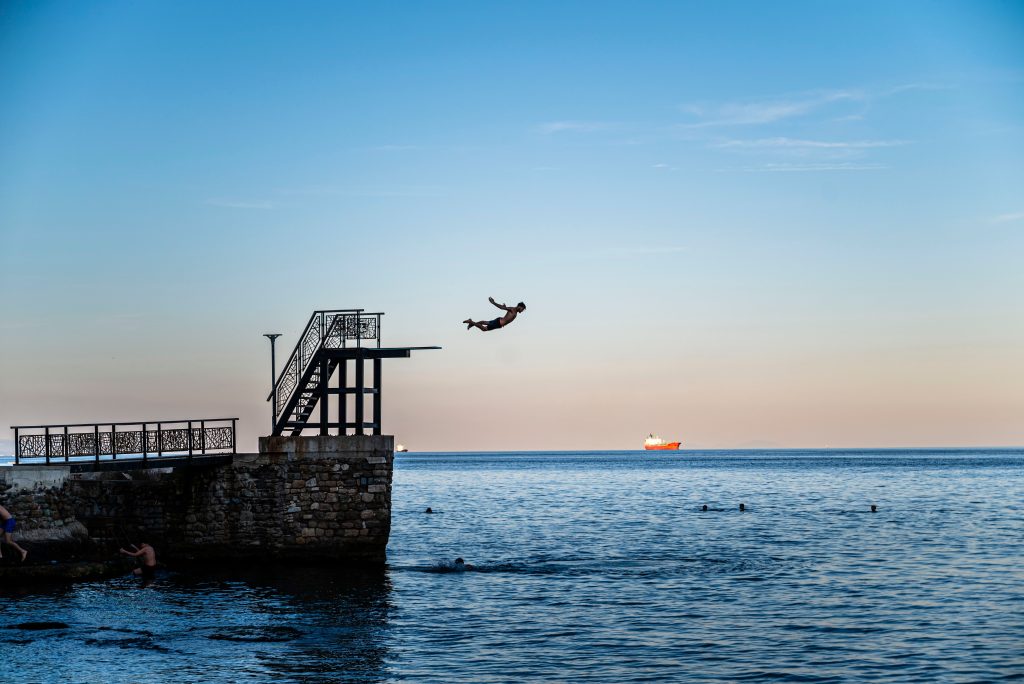
When I asked her to complete that sentence, “Are we really ready… to what?” she replied, “to jump off the diving board.” She described seeing herself at the end of the platform, peering down and being able to see the water. But she still worried that it looked murky. “What are we jumping into, exactly?”
Around the same time, I started working with a client who was a couple of years out from leaving his career. He wanted to get started getting his arms around the questions he’d need to answer. I asked him the question I ask many folks in this transition: what comes to mind when you think about retiring? His response: falling off a cliff.
Two Clients, One Fall
What struck me was that these two clients, at different stages of their post-work exploration, described a similar feeling. One imagined falling into a pool, the other into a cavernous abyss: free-falling with no clear sense of what was below.
I’ve always loved metaphors because they provide a rich summary of how someone is making sense of a situation through images, sensations, and concepts. When someone describes retirement as a free-fall, they’re not being dramatic. They’re providing an accurate report of what it feels like to step away from structures that organized their time, social life, identity, and sense of worth, and into open space.
Why “Free-Fall” in Retirement Captures the Feeling
The diving board and cliff images that these clients described have something in common. They’re the edge of a solid foundation that launches them into an in-between space before the next landing. In that space, you have little control, and perhaps even less information to predict what the landing will look and feel like. And that’s what the retirement transition can represent: a suspended state.
In that state, the primary questions I hear clients ask include:
Who am I, once the role is gone? For most of adulthood, what you do has been interchangeable in varying degrees with who you are. You scaffold together an identity with titles, a calendar of activities, and deliverables to people who depend on you. When those pieces start to come down, it can feel like losing your feet beneath you.
What holds your day together? A career hands you rhythms you don’t have to invent. You wake up, follow your routines, produce, and repeat. Some clients realize they took for granted how much of their days and nights were organized by outer demands. In the absence of a stabilizing platform, retirees can feel unmoored until they’ve designed a new foundation.
What am I jumping to next, not just away from? This is the question that clients understand but perhaps underestimate. Financial planning is very good at answering “can we afford to stop?” and encourages people to think about the question, “what’s next?” However, reallocating funds and making a list of activities are technical fixes. The deeper questions that arise after a period of traveling and trying out new hobbies can be disorienting. To steady oneself in a new retirement context is a developmental opportunity.
What Retirement Coaching Does with a Free-Fall
As I described to my diving board and cliff jumping clients, coaching doesn’t make the free-fall sensation go away. It’s the welcome mat to the land of transition. What coaching can do is shift how you relate to the fall, and help you become skillful at navigating the jumps in these ways:
It slows down the in-between space.
Instead of taking a single leap (e.g., one retirement date, one decision), we break down the transition into a series of emergent, and testable steps. You don’t have to know what the next three years look like, you can begin by wading intentionally into year one.
It builds the water or canyon floor below you.
Before you make a next jump, we work through questions such as identity, of who are you now and going forward? What values step back and which ones come forward as lenses for making choices? These are the steps of building a new foundation.
It puts the free-fall into words.
One of the most relieving things I hear clients say in coaching, in my group coaching program and in writing workshops is, “I’ve felt alone and I know now that I’m not.” Naming the fall, the fear, the uncertainty in this in-between space is in itself stabilizing. It is a trail marker to being human.
Coaching sets the pace of retirement as a practice.
Retirement planning is not a one-and-done or a problem to solve. This is often a shift that clients find to be a relief. Leaving work isn’t a decision you make and then head into the sunset. It’s an iterative process of making sense of what you’re trying, learning, and revising. The goal of coaching isn’t to construct a rigid concrete floor to jump onto indefinitely. It’s about growing the capacity to keep adjusting in mid-air, because there will be multiple launching points ahead.
Back to the Retirement Diving Board
By the end of our work together, Mary’s stance with her husband on that diving board had transformed. Rather than ask, “Are we ready to jump?” she said, “Let’s hold hands and leap into the pool, I’m ready to swim.” The shift from backing away from the edge to having the courage to get into the water is what readiness for retirement looks like.
If retirement feels like standing at the edge of some precipice, that’s not a sign that something is wrong. It’s a signal that you’re at the threshold of an in-between space with lots of ambiguity and opportunity. That edge is where coaching is most useful: not to talk you out of the fall, but to stand there with you while you design how to take the leap.
Let’s talk about what edge you’re standing on and ways to take your own leap.